Content marketers’ goal has moved from “page one on Google” to “a citation inside the AI answer.” This guide covers what AEO is, the three conditions AI actually cites, platform-specific tactics, and a 90-day execution roadmap.
What is AEO — three-line definitions vs SEO and GEO
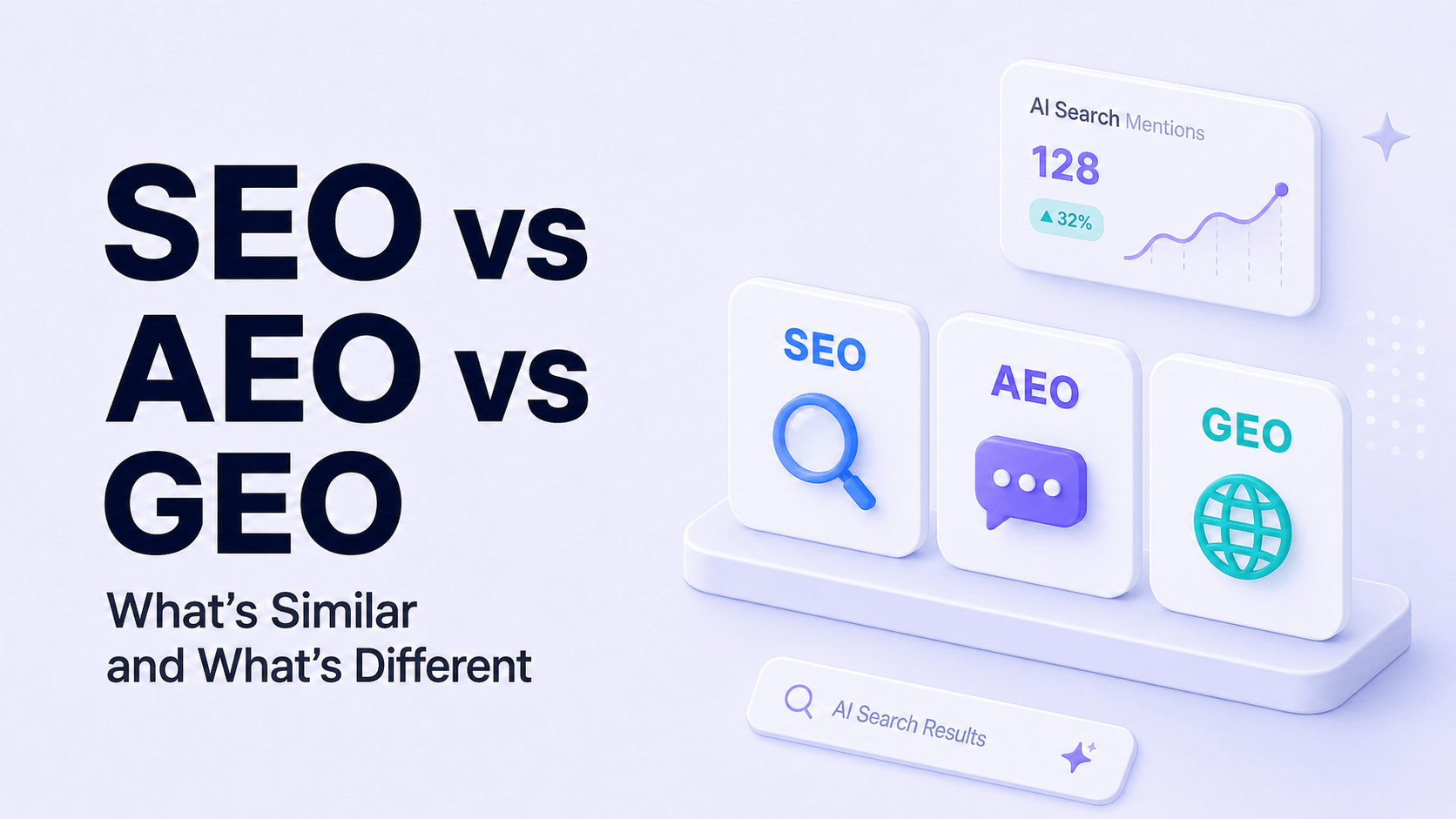
| Concept | Goal | KPI |
|---|---|---|
| SEO | Rank in search results → earn clicks | Rankings, CTR, organic traffic |
| GEO | Brand visibility inside AI-generated answers | Brand mention frequency |
| AEO | Optimize so AI answer engines cite your content directly | Citation share |
One-line definition: AEO (Answer Engine Optimization) is optimizing so AI answer engines—ChatGPT, Perplexity, Google AI Overviews—choose your content as a source when answering user questions.
As FirstPageSage notes, GEO and AEO are often used interchangeably in practice. The core idea is the same: AEO is a layer above SEO, not a replacement. As Google Search Central confirms, AI Overviews still run on existing indexing and quality systems. Technical SEO remains a prerequisite. For a deeper comparison, see SEO vs AEO vs GEO.
Why AI cites only certain pages — the AEO three-axis framework
Among hundreds of pages, AI picks specific ones for three reasons. The structure holds across platforms.
Axis 1: E-E-A-T × trust signals
AI models prioritize content with clear trust signals.
- Primary data: original research, experiments, interview quotes
- Author profile: make expertise explicit with Author Schema
- Lived experience: concrete stories like "our team’s A/B test showed…"
Start by creating a dedicated author bio page and connecting it with Person Schema.
Axis 2: Structurability (content AI can parse)
AI crawlers recognize structure and extract answer-ready units.
- Definition-led opening: define the core concept in the first 2–3 sentences
- Q&A blocks: put expected questions in H3s with answers immediately below
- Numbered lists and comparison tables: ordered info packs cleanly for citation
- Schema markup: apply FAQPage, HowTo, and Article Schema
Axis 3: Citability
The units AI extracts are self-contained statements of roughly 40–60 characters.
Not citable: "These methods can be effective in many situations."
Citable: "Pages with FAQ Schema see meaningfully higher AI Overviews citation rates."
Rewriting every key claim into this format is the essence of AEO editing.
A 58% CTR drop. Crisis or opportunity?
Some analyses show CTR falling by up to 58% when AI Overviews appear. Context changes the conclusion. Declines concentrate on informational queries (“what is…”, “how to…”), while transactional, brand, and local queries stay relatively stable.
More important: a new funnel has emerged.
Brand mention in AI answers → more branded search → traffic & conversions
Zero-click KPIs must change: CTR → citation share. CTR alone looks like a crisis. Tracking citation share reveals a new growth lever.
Platform-specific AEO citation tactics
Google AI Overviews
- Assume technical SEO is complete (Core Web Vitals, mobile optimization)
- Prioritize FAQPage Schema + stronger E-E-A-T
- Design pages to compete for Featured Snippets and AI Overviews together
ChatGPT (including GPT-4o live browsing)
- Plan for both training-cutoff knowledge and real-time Browse
- Publish consistent brand messages on owned channels and citable sources
- Build long-term trust via Wikipedia and industry media coverage
Perplexity
- Aim for the Sources panel: co-citation with high-authority domains
- Place short, dense answer sections for direct-answer queries
- Keep freshness with datePublished schema and regular updates
AEO tool workflow by team size
Place tools around a diagnose → gap analysis → restructure → remeasure loop.
| Team size | Recommended stack | Best use |
|---|---|---|
| Solo / small team | LLMPulse + Semrush AI Toolkit | Citation monitoring + keyword gap analysis |
| Agency / mid-large team | Profound + Peec AI | Dual verification for precise citation-share tracking |
A 90-day AEO execution roadmap
Days 1–30
Baseline diagnosis
Query your top 20 keywords in ChatGPT, Perplexity, and Google. Double-check citations with tools and manual review, then record a baseline citation-share number.
Without a number, you cannot tell what changed after 60 days.
Days 31–60
Convert top content for AEO
Apply three changes to your top 10 traffic pages.
- 1Insert a 40–60 character definition sentence in the first paragraph
- 2Add FAQPage Schema
- 3Add a TL;DR summary block (top or bottom of the page)
You do not need a full rewrite. Structure changes alone can shift citation patterns.
Days 61–90
Fill gaps + remeasure
- 1Remeasure citation share → gap analysis vs competitors
- 2Publish new pages for keywords AI cites but you do not cover
- 3Replicate winning page structures across other content
AEO optimization — shareable summary
AEO three-axis frame: (1) E-E-A-T trust signals → (2) AI-parsable structure → (3) citable 40–60 character statements. Content with all three captures AI answer-engine traffic.
One thing you can do today: ask ChatGPT and Perplexity your top five keywords. If you are not cited, add a 40–60 character definition to the first paragraph and FAQPage Schema — that is move one. Continue with the AEO content writing guide and AI citation content structure guide.
Is your content getting cited by AI?
Run a free Alleo diagnosis to check SEO, GEO, and AEO readiness — then close the structure gaps that block citations.
Frequently asked questions
Q1. What is AEO?
AEO (Answer Engine Optimization) is the practice of optimizing content so AI answer engines—ChatGPT, Perplexity, Google AI Overviews—select it as a source when responding to users. It is a layer on top of SEO, not a replacement, and the core KPI is citation share.
Q2. Why do AI engines cite only certain content?
The AEO three-axis framework explains it: (1) E-E-A-T and trust signals (primary data, author profiles, real experience), (2) structurability (definition-led openings, Q&A, tables, schema), (3) citability (self-contained 40–60 character statements). Content with all three axes is more likely to be selected.
Q3. Is a CTR drop from AI Overviews a crisis?
Informational queries can see CTR drops up to 58%, while transactional, brand, and local queries stay relatively stable. More important is the new funnel: brand mention in AI answers → branded search → traffic and conversions. Shift KPI focus from CTR to citation share.
Q4. What should I do first in a 90-day AEO roadmap?
In days 1–30, query your top 20 keywords in ChatGPT, Perplexity, and Google. Double-check citations with tools and manual review, then record a baseline citation-share number. Without a baseline, you cannot measure change at day 60.