Rankings look fine but traffic drops? The landscape changed — not necessarily your team. ChatGPT Search, Perplexity, and Google AI Overviews accelerate zero-click behavior; rankings and AI citations decouple. SparkToro zero-click research suggests roughly 60% of Google searches ended without a click in 2024. This guide gives marketers five criteria you can verify in proposals and meetings before signing a GEO partner.
Why GEO agency selection got harder in 2026
After 2025, many SEO agencies rebranded as "GEO specialists." Titles alone no longer separate real capability from marketing copy.
A good SEO agency is not automatically a good GEO agency.
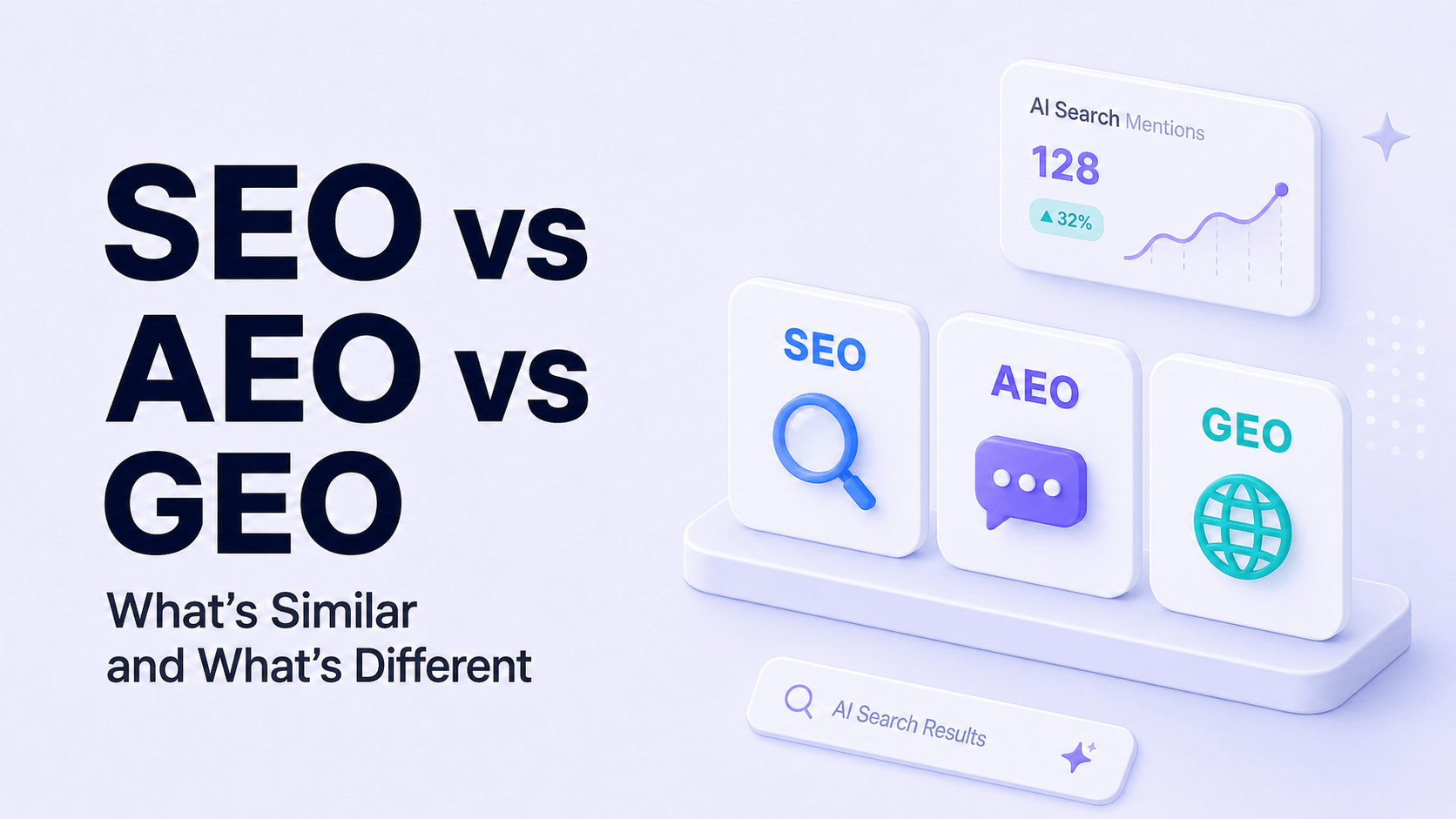
GEO is a different game: entity optimization, multi-engine citation tracking, and structured data — not keyword rankings.
SEO persuades crawlers; GEO makes you a trusted source in model training and live retrieval. Partners who understand that gap deliver different outcomes six months later. Start with What is GEO? if you need the basics first.
Five core criteria for choosing a GEO agency
Per-engine citation tracking
Confirm they can track and report Google AI Overviews, Perplexity, and ChatGPT Search separately. Ownership of GEO-specific tools such as Profound or Otterly.ai — plus real sample reports — is evidence of capability.
Practical check: Ask: "Show recent three-month Perplexity citation counts for an existing client." Agencies that report Google only are SEO shops in 2026, not GEO partners.
E-E-A-T build strategy
Look for author schema design, real bylines from experts, and production of citable primary data in the proposal. Check domain authority distribution of mention sources in the portfolio — not content volume alone.
Practical check: Proposals that only push "X posts per month" are a warning sign. One piece cited on three authoritative domains beats thirty posts on low-authority sites for GEO outcomes.
Entity graph capability
AI models organize information around entities, not keywords. If your brand is missing from AI's knowledge graph, content alone will not earn citations.
- Google Knowledge Graph registration experience
- Wikidata item creation and maintenance
- Brand–product–person entity linking design
Practical check: Ask for a pre-meeting entity coverage diagnosis for your brand. Concrete answers signal a real GEO agency; "we will check after onboarding" is a red flag.
Quantitative AI readiness metrics
"We do GEO well" is qualitatively different from "AI readiness score +18 after three months of onboarding."
- Diagnose → strategy → execution → re-measure cycle is explicit
- Before/After data is shown for real clients
- KPIs include citation rate or AI visibility frequency
Practical check: If they only report traffic changes, they are delivering SEO, not GEO.
Multi-format content design
AI search engines cite FAQ Schema, HowTo Schema, video transcripts, and research reports — not blog posts alone. Choose partners who design information architecture and distribution formats, not just publishing cadence.
- FAQ hub pages with structured data
- Video content + transcript optimization
- First-party survey and data reports (citable statistics)
- Podcast episode summary documents
Per-engine citation tracking — minimum vs excellent
| Target | Minimum | Excellent |
|---|---|---|
| Google AI Overviews | Monthly captures | Query-level citation frequency |
| Perplexity | Brand mention count | Source URL-level analysis |
| ChatGPT Search | Qualitative monitoring | Quantitative citation rate reporting |
For E-E-A-T strategy, also review Google's helpful content guidelines.
In-house vs agency: a decision frame
When in-house makes sense
- YMYL sectors where internal expert E-E-A-T is the core advantage
- Annual GEO budget under roughly ₩30M (agency minimums may invert ROI)
- Team can quickly turn proprietary data and interviews into content
Minimum stack in-house: one diagnosis tool (e.g. Otterly.ai) and one citation tracker. Without that, starting is hard.
When agency outsourcing makes sense
- No internal talent for schema design and implementation
- Speed beats learning curve (launch, competitive markets)
- Need multi-engine tracking and reporting built from scratch
Practical alternative: hybrid model
Safest for most mid-size brands.
Keep in-house
- Brand tone and core messaging
- Expert interviews and first-party data
- Final fact-checking
Delegate to agency
- Entity structure and Knowledge Graph registration
- Schema markup implementation
- Multi-engine citation tracking and monthly reporting
Five questions to prepare before the meeting
Ask in order. Specificity of answers equals real capability.
1. Which tools do you use to track citations by engine?
→ If they cannot name tools immediately, or say "Google Search Console," be cautious.
2. Can you bring our brand entity diagnosis to the first meeting?
→ Agencies that show up without pre-work prioritize sales over GEO capability.
3. Besides traffic, what metrics do you report?
→ No citation rate or AI visibility frequency means SEO agency, not GEO.
4. Show AI readiness score improvements with Before/After numbers.
→ Qualitative case studies only suggest no quantitative tracking infrastructure.
5. What must we handle internally?
→ "Leave everything to us" is a risk signal. Clear role split is a trust signal.
Demand numbers, not list comparisons
The trap is choosing by fame. The question is one: can they show numbers?
- Citation tracking data — concrete numbers by engine and period
- Entity diagnosis — coverage gaps and competitor gap analysis
- AI readiness score change — Before/After from onboarding
Copy the five questions into your next meeting agenda. To assess current state before hiring an agency, see our Alleo AI website analysis guide.
Check AI readiness with numbers first
Before picking a partner, measure your brand's AI visibility. Alleo's free diagnosis covers SEO, GEO, and AEO in one pass.
Frequently asked questions
Q1. Is a good SEO agency automatically a good GEO agency?
No. GEO requires entity optimization, multi-engine citation tracking, and structured data design — not keyword rankings. SEO persuades crawlers; GEO makes you a trusted source in AI training data and live retrieval.
Q2. What should I verify first in a GEO agency meeting?
Per-engine citation tracking. Ask whether they track Google AI Overviews, Perplexity, and ChatGPT Search separately, and request GEO tools (Profound, Otterly.ai) plus sample reports.
Q3. In-house GEO vs agency — how to decide?
In-house fits YMYL brands, budgets under roughly ₩30M/year, and teams that can produce first-party data quickly. Agency fits missing schema talent and need for multi-engine tracking from day one. Most SMBs do best with hybrid: internal tone, interviews, fact-check; external entity, schema, citation reporting.
Q4. Red flags in a GEO agency proposal?
Volume-only pitches, Google-only reporting, traffic-only KPIs, no pre-meeting entity diagnosis, and "we handle everything." If they cannot show citation data, entity gaps, and readiness Before/After, the name may say GEO but the delivery may not.