Is SEO dead? — Let's look at the data
We'll answer the most common question directly. SEO is not dead. But SEO alone is no longer enough.
📉 Traffic decline
- Over one yearGlobal publisher Google search traffic decline~33%
Source: Chartbeat · Reuters Institute 2026
- Nov 2024–Q2 2025HubSpot organic traffic loss70–80%
Source: HubSpot CEO Q1 2025 earnings call
- 2022–2025Business Insider search traffic decline55%
Source: Similarweb · WSJ
- News publishers expect search traffic decline over next 3 years43%
Source: Reuters Institute 2026 report
🤖 Shift to AI search
- One year ago → nowB2B decision-makers starting purchase research with AI tools24% → 84%
Source: Wynter 2026 buyer research
- CTR drop for #1 page when AI Overview appears~58%
Source: Ahrefs 2025.12
The key point: rank stays the same but clicks disappear. HubSpot CEO Yamini Rangan said on the Q1 2025 earnings call that traffic declines are due to AI Overviews—AI answers solve the query directly, so fewer people visit websites. Without adding AEO and GEO on top of SEO assets, the same #1 rank can mean less than half the traffic.
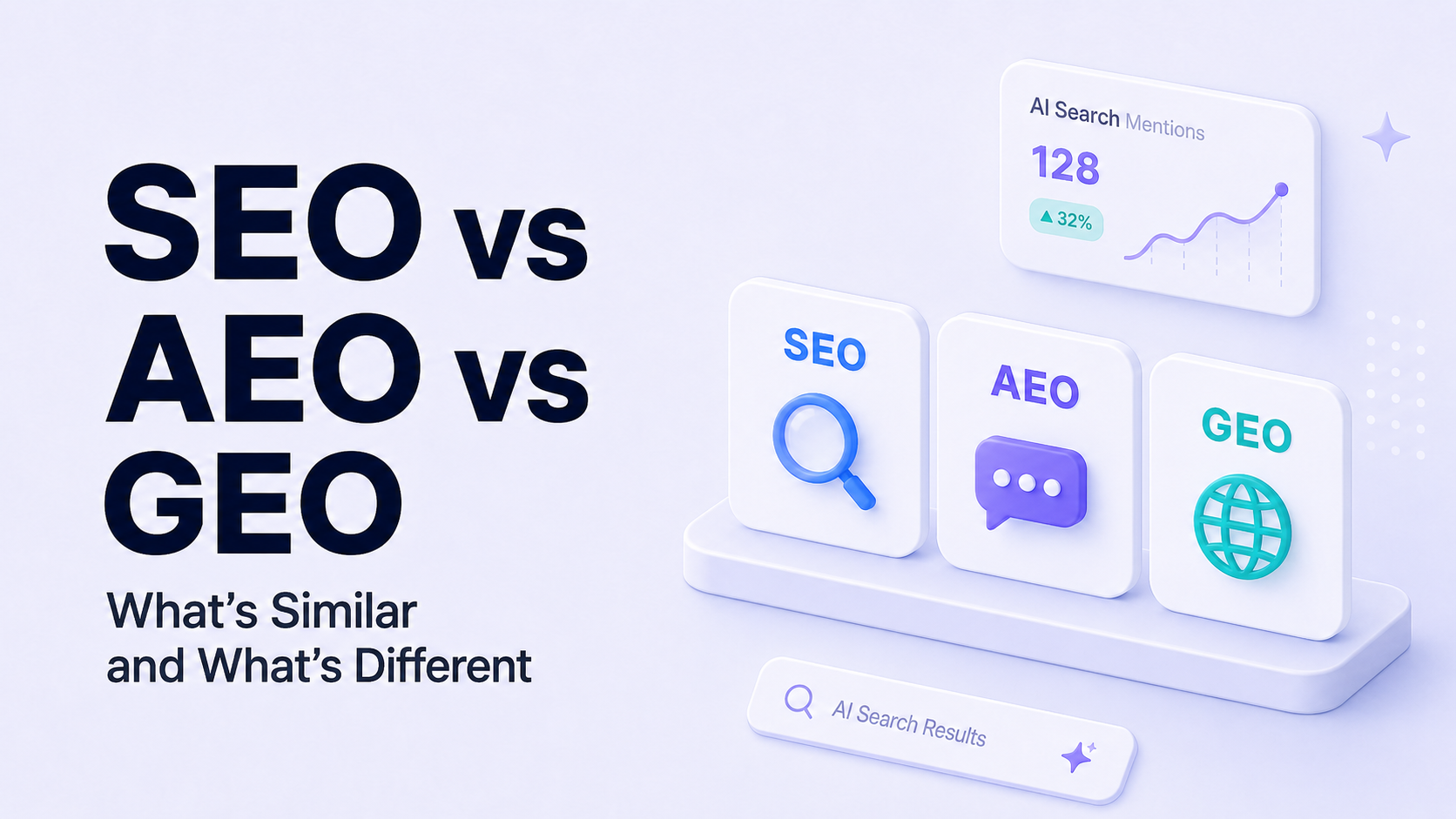
Definitions of the three concepts
- SEO
Search Engine Optimization
Optimizing so your pages rank high on search engines (Google, Bing, etc.). The goal is traffic through clicks.
- AEO
Answer Engine Optimization
Optimizing so answer engines (ChatGPT, Claude, Perplexity, Google AI Overview) cite and reference your content when answering user questions. The goal is citations inside AI answers.
- GEO
Generative Engine Optimization
A broader practice of making AI models learn to trust and use your brand and content as sources—even when your brand appears in answers without a citation link. The goal is visibility and authority in generated answers.
In practice, AEO and GEO are often used interchangeably. This article distinguishes them because measurement and emphasis differ.
Core comparison table
| Item | SEO | AEO | GEO |
|---|---|---|---|
| Goal | Search result clicks | Citations in AI answers | Brand visibility in AI answers |
| Optimization unit | Page | Paragraph | Entity |
| Primary channels | Google, Bing | ChatGPT, Perplexity, Claude, AI Overview | LLM training/response broadly |
| Content format | Keyword optimization, long-form, backlinks | Answer-first, Q&A, structured data | Authority signals, consistent brand message, external mentions |
| Key metrics | Keyword rank, organic traffic, CTR | Citation frequency, answer share | Brand mention rate, category visibility |
| Measurement tools | Google Search Console, GA | LLM citation monitoring tools | Brand tracking, prompt monitoring |
| Time to results | 3–6 months | 2–4 weeks (RAG path) | Model update cycles |
| Core assets | Backlinks, domain authority | Answer-ready paragraphs, FAQ | Brand awareness, external citations |
What's the same — ~80% shared ground
All three require the following in common.
1. Content quality
Accurate, deep content with primary data works across all three.
2. E-E-A-T signals
Author info, sources, update dates, and institutional credentials are trust signals for both search engines and AI.
3. Technical foundation
Crawler access (robots.txt), site speed, mobile compatibility, and site structure affect all three.
4. Backlinks and external citations
Domain authority works in AEO and GEO too. AI prioritizes content that authoritative sites mention often.
5. Structured data (JSON-LD)
Article, FAQPage, HowTo schema clearly communicate content structure to search engines and AI.
If you already have SEO assets, ~80% of AEO and GEO is in place. You are not starting from zero.
What's different — 3 core differences
1. Optimization unit differs
SEO thinks in pages—one page owns one keyword cluster. AEO thinks in paragraphs—one paragraph answers one question. AI does not read the whole page; it picks answer-ready paragraphs. Seer Interactive finds ~44% of LLM citations come from the first 30% of text. Placing conclusions up front is not style advice—it is a quantitatively proven signal.
2. Measurability differs
SEO has Google Search Console and GA. AEO has no standard tooling yet. Ask ChatGPT the same question 100 times and cited brands shift slightly each time. Tracking uses repeated prompt monitoring—define a core question set and log citation presence and frequency weekly or monthly.
3. Traffic model differs
SEO: click equals traffic. AEO/GEO: citation equals exposure, but may not lead to clicks. Pew Research finds users click cited links in AI Overviews only ~1% of the time. Yet citations build brand awareness and trust, and users often search your brand name directly days later (direct/brand search). Measurement timing and units differ.
Coexistence model — why you need all three
The three are not sequential steps but layers.
GEO
AI models trust our brand
AEO
Our content is cited in AI answers
SEO
Our pages are discovered in search
Foundation
Content quality + site trust + technical SEO
SEO is the foundation for discovery. To be cited in AI answers, you must first be discoverable in search. AEO adds answer-readiness on top; GEO adds brand authority. Doing only one dilutes impact; doing all three creates synergy.
You can decide where to invest by symptom.
- Good rank but falling traffic → AEO gap. Content is not structured for AI extraction.
- Traffic exists but you don't appear in ChatGPT or Perplexity category searches → GEO gap. External citations and authority signals are weak.
- Not showing up in search → SEO gap. Revisit fundamentals.
4 steps to convert SEO assets to AEO
If you have existing SEO assets, restructure them AEO-friendly in this order.
Restructure for answer-first
Put the core answer in the first paragraph. Burying the conclusion at the end hurts AEO. Start by adding a summary box or key takeaway paragraph at the top.
Add FAQ section + schema
One of the fastest wins. Add five Q&A items at the end and apply FAQPage JSON-LD schema. AI cites Q&A format especially well.
Strengthen citable data points
Replace abstract statements like "it's effective" with concrete numbers like "conversion rose 32%." Add primary data, statistics, and definitions throughout.
Start citation monitoring
Define a core question set and track how often your brand is cited in ChatGPT, Perplexity, and Claude over time. Use a dedicated tool like Alleo if doing it manually is hard.
5 misconceptions marketers make most often
Myth 1. "SEO is dead, so we should stop SEO."
Search is still the largest discovery channel. Split investment between informational content (AEO) and transaction/local content (still SEO-heavy).
Myth 2. "Add JSON-LD and AEO is done."
Structured data is one signal. Schema alone without answer-first structure, data points, and authority signals has limited effect.
Myth 3. "AEO only works for English content."
LLMs cite content in the language of the answer. With hundreds of millions of ChatGPT users globally, non-English markets can be less competitive entry points.
Myth 4. "Publish more content and AI will cite us."
Volume is not the deciding variable in AEO/GEO. Ten authoritative, well-structured articles beat a hundred keyword-stuffed ones. Author info, sources, and citable data are what matter.
Myth 5. "AEO and GEO are completely different work."
In practice they overlap ~90%. Measurement and emphasis differ; content principles are nearly identical.
Alleo checks all three
Alleo's free diagnosis scores SEO, AEO, and GEO separately so you see where the biggest gaps are and what to fix first. Enter your domain and get results in about five minutes.
Frequently asked questions
Q1. If you had to pick only SEO or AEO, which one?
The answer is not to create that choice. If resources are limited, companies with lots of informational content should start with AEO; transaction and local businesses should start with SEO.
Q2. Are AEO and GEO really different?
In practice they are used almost interchangeably. AEO emphasizes citations inside answers; GEO looks more broadly at brand visibility in generated answers. Many teams use both terms together.
Q3. We have almost no SEO assets. Can we start with AEO?
Yes, but weak fundamentals limit results. Site speed, mobile compatibility, and robots.txt settings are the foundation for AEO and GEO. Check both at the same time.
Q4. Will starting AEO hurt SEO traffic?
It tends to help SEO. Answer-first structure, FAQ sections, and structured data also increase chances of featured snippets. AEO-friendly structure is largely search-engine-friendly too.
Q5. How quickly does AEO show results?
Citations via RAG (real-time web search) typically show first changes within 2–4 weeks. GEO effects from inclusion in model training data can take longer, depending on model update cycles.
References
- Reuters Institute, Journalism, Media and Technology Trends and Predictions 2026
- Chartbeat, Global Publisher Search Traffic Analysis (2026)
- Pew Research Center, AI Search Behavior Study (2025)
- Seer Interactive, AIO Citation Analysis (2025~2026)
- Ahrefs, AI Overview CTR Impact Study (2025.12)
- HubSpot, Q1 2025 Earnings Call Transcript