Even if you rank #1 on Google, that position loses meaning if AI keeps recommending competitors. This article explains why CEP matters, how it is structured, and the first steps Korean small businesses can take right now.
Why a new metric is needed in the AI search era
The search paradigm is shifting. We are moving from an era where users typed keywords into Google and scanned ten blue links to one where they ask AI and get an answer immediately.
Here is data that shows the scale of this change.
| Source | Key figure | What it means |
|---|---|---|
| Gartner (2025 forecast) | 25% drop in traditional search engine traffic by 2026 | 1 in 4 search visits will move to AI search |
| Ahrefs (AI Overview research) | 58% CTR drop for traditional #1 when AI Overview appears | Even at Google #1, clicks can fall by more than half when AI shows the answer first |
We are entering an era where Google rank #1 means little if AI does not recommend you. Traditional SEO metrics cannot capture this shift. We need a new standard that measures "is my content cited by AI?" and, more importantly, "is it cited more often and in better context than competitors?"
That standard is CEP (Competitive Engine Performance).
Definition of CEP (Competitive Engine Performance)
CEP is a framework that measures "brand exposure performance in AI engines relative to competitors."
Broken down:
- Competitive: A comparison lens. It looks at relative position, not absolute numbers.
- Engine: AI search engines — ChatGPT, Perplexity, Google AI Overviews, Naver AI, and others.
- Performance: Overall performance combining exposure frequency, exposure context, sentiment (positive/negative), and market fit.
Concepts for AI search optimization already existed. AEO (Answer Engine Optimization) optimizes for inclusion in AI answers, and GEO (Generative Engine Optimization) optimizes for generative AI engines. CEP goes one step further by adding the comparison question: "Are we doing well not just in absolute terms, but better than competitors?"
If SEO asks "what rank are we on Google?",
AEO asks "does AI cite us?",
CEP asks "does AI recommend us over competitors?"
Five dimensions that make up CEP
CEP is not a single number. It is built from five dimensions to measure AI search competitiveness from multiple angles.
| Dimension | Description | Impact on AI citations |
|---|---|---|
| Brand awareness | How well AI engines know our brand | The brand name must appear enough in training data for AI to cite it |
| Market competitiveness | AI exposure frequency rank vs. competitors in the same industry | If competitors are mentioned first for the same question, CEP falls behind |
| Exposure quality | In what context does AI cite us? | Value differs between simple listing, #1 recommendation, and detailed explanation |
| Brand sentiment | Does AI mention us positively? | Negative-context citations can actually harm the brand |
| Country-specific market fit | Is AI exposure appropriate in the target market (Korea)? | Global AI engines return different results by region, so Korea-fit exposure matters |
Together, these five dimensions give a three-dimensional view of where your brand stands relative to competitors in AI search.
How CEP differs from traditional SEO/AEO
When you first encounter CEP, you may wonder how it differs from SEO or AEO. Here are the key differences in a table.
| Category | SEO | AEO | CEP |
|---|---|---|---|
| What it measures | Search engine result page (SERP) rank | Whether you appear in AI answers | AI exposure performance vs. competitors |
| Core question | "What rank are we on Google?" | "Does AI cite us?" | "Does AI recommend us over competitors?" |
| Perspective | Absolute rank | Included / not included | Relative comparison |
| Target engines | Google, Naver, and other search engines | ChatGPT, Perplexity, and other AI answers | ChatGPT, Perplexity, Google AI Overviews, Naver AI, and others |
| Optimization strategy | Keywords, backlinks, site speed | Structured data, clear answer structure | E-E-A-T strengthening, brand mention expansion, competitor gap analysis |
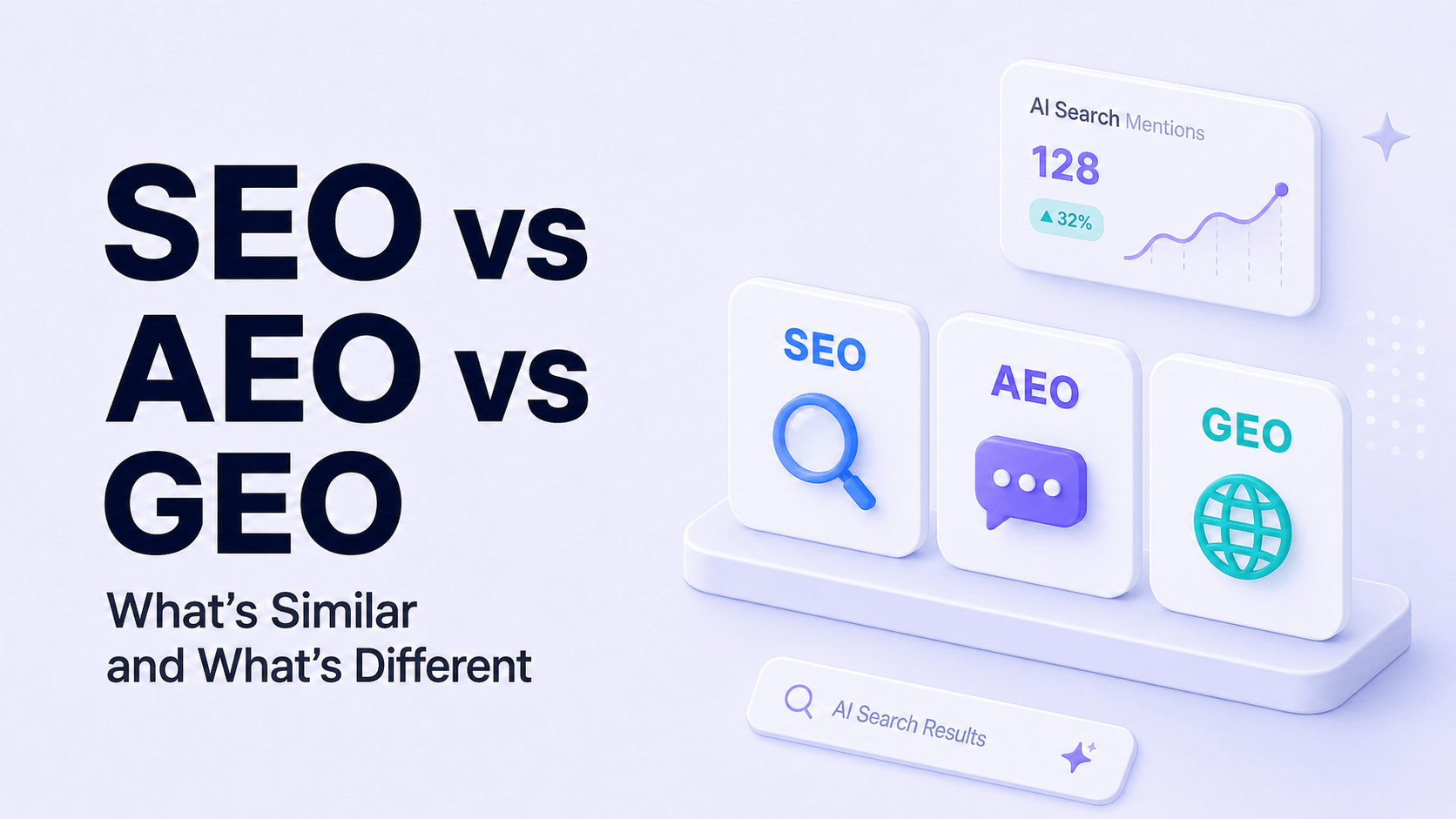
SEO, AEO, and CEP are not opposing concepts. SEO is the foundation, AEO is the extension into the AI era, and CEP is the strategic lens for understanding your position relative to competitors. You need all three to see the full picture of the AI search era.
Why CEP matters for Korean small businesses
80% of top AI exposure slots by industry are still empty
OpenTime analyzed 200 Korean SMBs and reported that roughly 80% of the top AI search positions by industry are still unclaimed. That means if you start now, you can claim the #1 AI search position in your industry with little competition.
Think back ten years. There was a time when a few well-written Naver blogs could get you to the top of search. AI search is exactly at that moment right now. The difference: back then it was SEO; now it is CEP.
Global AEO tools are too expensive for Korean SMBs
The market for tools that manage AI search exposure is growing fast globally, but pricing is a problem.
| Tool | Monthly price | Accessibility for Korean SMBs |
|---|---|---|
| xSeek | $249.99+ (~₩330,000+) | English-first, high price |
| Profound | Enterprise only | Not aimed at Korean SMBs |
| Ahrefs Brand Radar | $99+ (~₩130,000+) | SEO-focused, not AEO-specialized |
| OpenTime (Korea) | Free diagnosis + paid consulting | Diagnosis available but focused on 8 professional-service industries |
| Ansir (Korea) | Free diagnosis | Technical metrics only, no optimization execution features |
| Alleo (Korea) | All features currently free | Built for Korean SMBs — analysis + content + social in one |
Global tools often cost ₩300,000–500,000 per month — hard for Korean small businesses to afford. Korea has emerging AEO tools like OpenTime and Ansir, but most are diagnosis-only or consulting-based models.
How to raise CEP — actionable first steps
CEP means nothing as a concept alone. To get ahead of competitors in AI search, you can start these three things right now.
1. Create E-E-A-T-based content
2. Strengthen structured data (JSON-LD)
3. Start with an AI search exposure diagnosis
For example, when AI answers "recommend Pilates studios in Gangnam," it prioritizes businesses with blog content containing the owner's real experience and student interviews. Simple keyword-stuffing posts are less effective in the AI era.
Alleo currently offers all features free, including comprehensive AI website analysis (SEO/GEO/AEO/CEP/keywords). From analysis to blog publishing, interview-based content generation, and automated social posting — it is a self-service SaaS Korean SMBs can use directly. Start with Alleo for free
Frequently asked questions
Q1. How is the CEP score measured?
CEP measures five dimensions together: brand awareness, market competitiveness, exposure quality, brand sentiment, and country-specific market fit. It compares how often and in what context your brand and competitors are cited across major AI search engines — ChatGPT, Perplexity, Google AI Overviews, Naver AI, and others — for specific questions.
Q2. Are CEP and AEO the same thing?
No. AEO (Answer Engine Optimization) is a strategy to optimize your content so it appears in AI answers. CEP (Competitive Engine Performance) adds a competitive comparison lens — measuring not just "does AI cite me?" but "am I cited better than competitors?" AEO is the optimization strategy; CEP is the performance metric that evaluates results relative to competitors.
Q3. Can small businesses use CEP too?
Yes — and it may be even more advantageous for SMBs. In Korea, roughly 80% of the top AI search positions by industry are still unclaimed, so starting now means you can secure them with little competition. Global AEO tools often cost $250+ per month, but Korea-focused free tools like Alleo let you start CEP analysis and improvement without that cost burden.
Q4. How long does CEP improvement take?
It depends on your industry and current state, but if you consistently publish E-E-A-T-based content, you can usually see changes in AI search citations within 3–6 months. Because AI search is still early-stage, you can often see results faster than in saturated traditional SEO. The key is to start now.
Q5. Is there a free tool to analyze CEP?
Yes. Alleo provides integrated SEO, GEO, AEO, CEP, and keyword analysis through its comprehensive AI website analysis — and all features are currently free. It is tailored for Korean SMBs, making it more accessible than English-first global tools. Early-bird signup is available at alleo.pro.