"I asked ChatGPT about our shop — why didn't it show up?"
The way customers search is changing. Instead of typing "best pasta in Gangnam" into Naver, they ask ChatGPT, "Recommend a pasta place near Gangnam Station that's good for a date." The problem is that if AI does not know your business, it will never appear in the answer.
If traditional SEO (search engine optimization) was about ranking higher on Google and Naver, AEO (AI search optimization) is about getting your brand mentioned inside AI answers. So what criteria does AI actually use to decide "this brand is worth recommending"?
How AI search recommends brands
Large language models like ChatGPT combine training data with real-time web search results to generate answers. The key question is: "Is there enough consistent, trustworthy information about this brand everywhere?"
If information exists on only one blog, AI will not feel confident. When the same story repeats across multiple sources, AI finally decides, "this is worth recommending."
AI cross-checks information across the web.
It recommends only when the same story appears in multiple places.
Three criteria AI looks for
When ChatGPT recommends a brand, it checks the three criteria below first. Even improving one of them raises your odds of becoming an "answer candidate."
Trust
"Can I trust this brand?"
Is your business name, address, and phone number identical across your website, blog, social media, and map listings?
Do you have real customer reviews on Naver Place, Google Reviews, and similar platforms?
Are other sites or articles mentioning your brand?
Expertise
"Are they a real expert in this field?"
If you run a flower shop, publish posts like "seasonal flower care tips" and "how to choose a wedding bouquet" on a regular basis.
Content that shows a real person — such as "tips from a florist with 15 years of experience" — is a strong expertise signal for AI too.
Because AI is built to find answers to questions, FAQ-style content is easier to cite.
Structured data
"Can AI read it?"
Fill in your category, hours, photos, and service items completely. Structured data that AI can reference is generated automatically.
Your business name, address, contact details, and service descriptions must be written clearly as text — not buried in images.
Check that page titles and descriptions match the actual content.
Criterion 1: Trust — what AI checks specifically
Trust is the first thing AI evaluates. It combines the signals below to make a judgment.
| Trust signal | What AI checks |
|---|---|
| Consistent information | Business name, address, and phone number match across website, blog, social media, and map listings |
| Reviews and reputation | Real customer reviews on Naver Place, Google Reviews, and similar platforms |
| External mentions | Whether other sites and articles mention your brand |
Even a neighborhood bakery can become "trustworthy" to AI with 30 Naver blog reviews, a 4.5 Google rating, and one local media mention. On the other hand, if your website says "Hapjeong" but Naver says "Mangwon," AI gets confused and may skip recommending you altogether.
Criterion 2: Expertise — the same context as E-E-A-T
AI prefers brands with in-depth content on a specific topic. This is the same context as Google's E-E-A-T (Experience, Expertise, Authoritativeness, Trustworthiness). The practical steps are simpler than you might think.
- Build expert content on your blog: If you run a flower shop, publish posts like "seasonal flower care tips" and "how to choose a wedding bouquet" on a regular basis.
- Show the owner's experience: Content that shows a real person — such as "tips from a florist with 15 years of experience" — is a strong expertise signal for AI too.
- Question-and-answer content: Because AI is built to find answers to questions, FAQ-style content is easier to cite.
Even 2–3 blog posts per month can create the impression that "this person really knows this field."
Criterion 3: Structured data — a format AI can read
No matter how good your information is, it is useless if AI cannot read it. Structured data is code that organizes page information so machines can understand it — for example, labeling "this is business hours, this is the address."
- Complete your Google Business Profile: Fill in your category, hours, photos, and service items completely.
- Organize basic information on your website: Your business name, address, contact details, and service descriptions must be written clearly as text — not buried in images.
- Check your meta tags: Confirm that page titles and descriptions match the actual content.
This may feel technically difficult, but with Alleo's comprehensive website analysis, you can get a report showing which structured data is missing from your site.
Three things small business owners can do right now
Enough theory for now. Here is a checklist you can execute starting today.
Unify your information (30 minutes)
Check that your business name, address, and phone number are 100% identical across your website, Naver Place, Google Business Profile, and Instagram profile — and fix any mismatches.
Write one piece of expert content (1 hour)
Pick the question customers ask most often and answer it thoughtfully in a blog post. A "frequently asked questions" format gives you an edge for AI citations.
Complete your Google Business Profile 100% (20 minutes)
Fill in every empty field. Service items and photos in particular have a direct impact on AI citations.
Even these three steps greatly increase the chance that AI will treat your brand as an "answer candidate." In the AI era, marketing starts not with a big budget, but with accurate, consistent information.
Frequently asked questions
Q1. Does it cost money to get ChatGPT to recommend our brand?
Registering a Google Business Profile, unifying your information, and writing blog posts can all be done for free. You can raise your chances of AI recommendations through information quality and consistency alone — no ad spend required.
Q2. If I do SEO well, does AEO happen automatically?
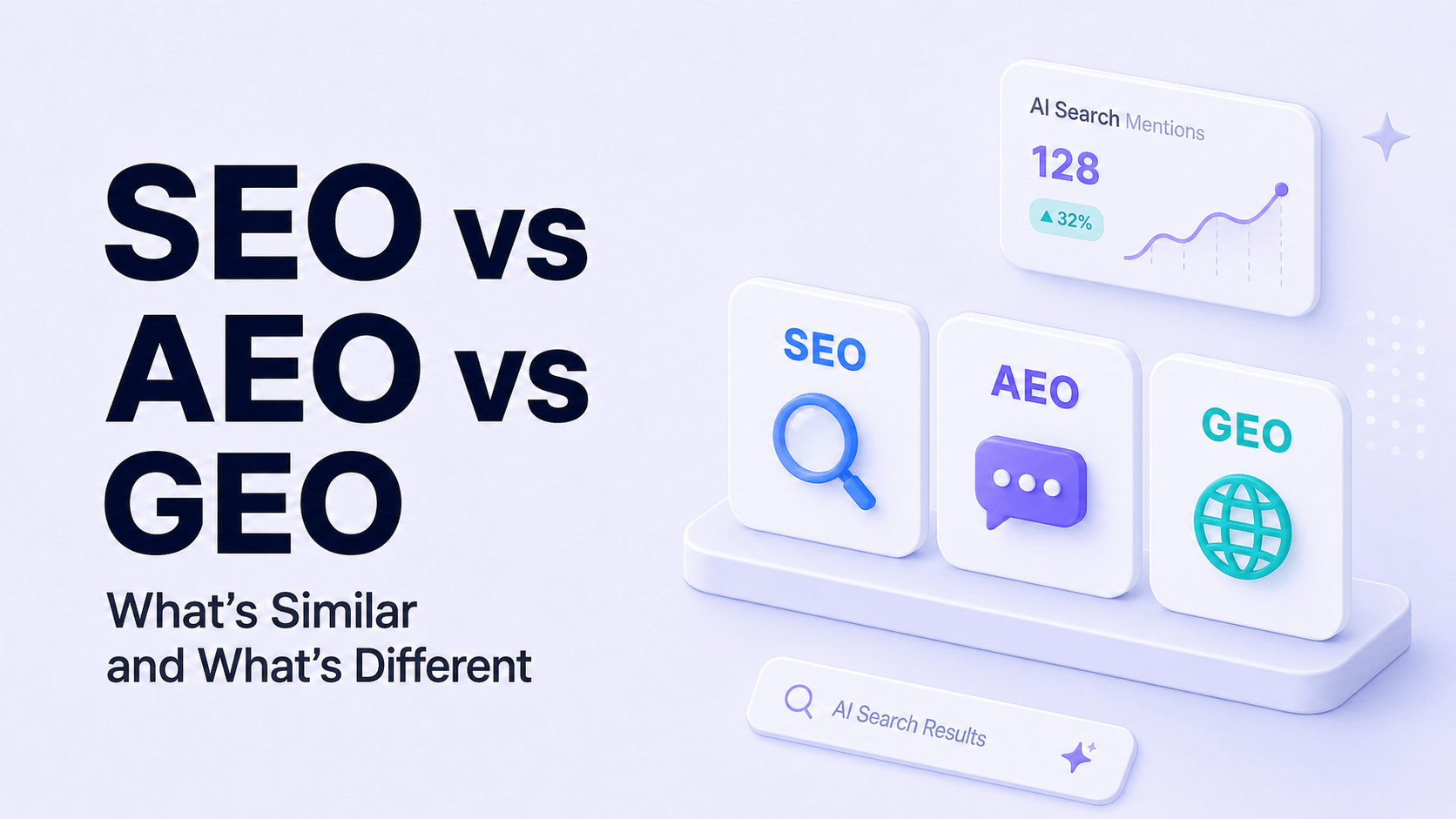
There is significant overlap, but they are not exactly the same. SEO (search engine optimization) focuses on search result rankings, while AEO (AI search optimization) aims to get cited in AI answers. AEO requires additional strategies such as question-and-answer content structure and clear, fact-based writing.
Q3. How long does it take to see results from AI search recommendations?
It depends on how often AI models refresh web data, but if you combine structured data improvements with steady content publishing, you can usually feel a change within 4–8 weeks.