What is GEO — explained simply
GEO stands for Generative Engine Optimization — making your content work for AI-generated answers.
These days, people ask AI directly instead of searching Naver (Korea's major portal) or Google. Ask "Recommend a nice café near Gangnam Station" and AI generates an answer on the spot. It builds that answer from content across the web.
GEO is the work of making sure your content gets chosen as that raw material. Think of a chef (AI) picking ingredients (content) — GEO helps your business information get selected like fresh produce.
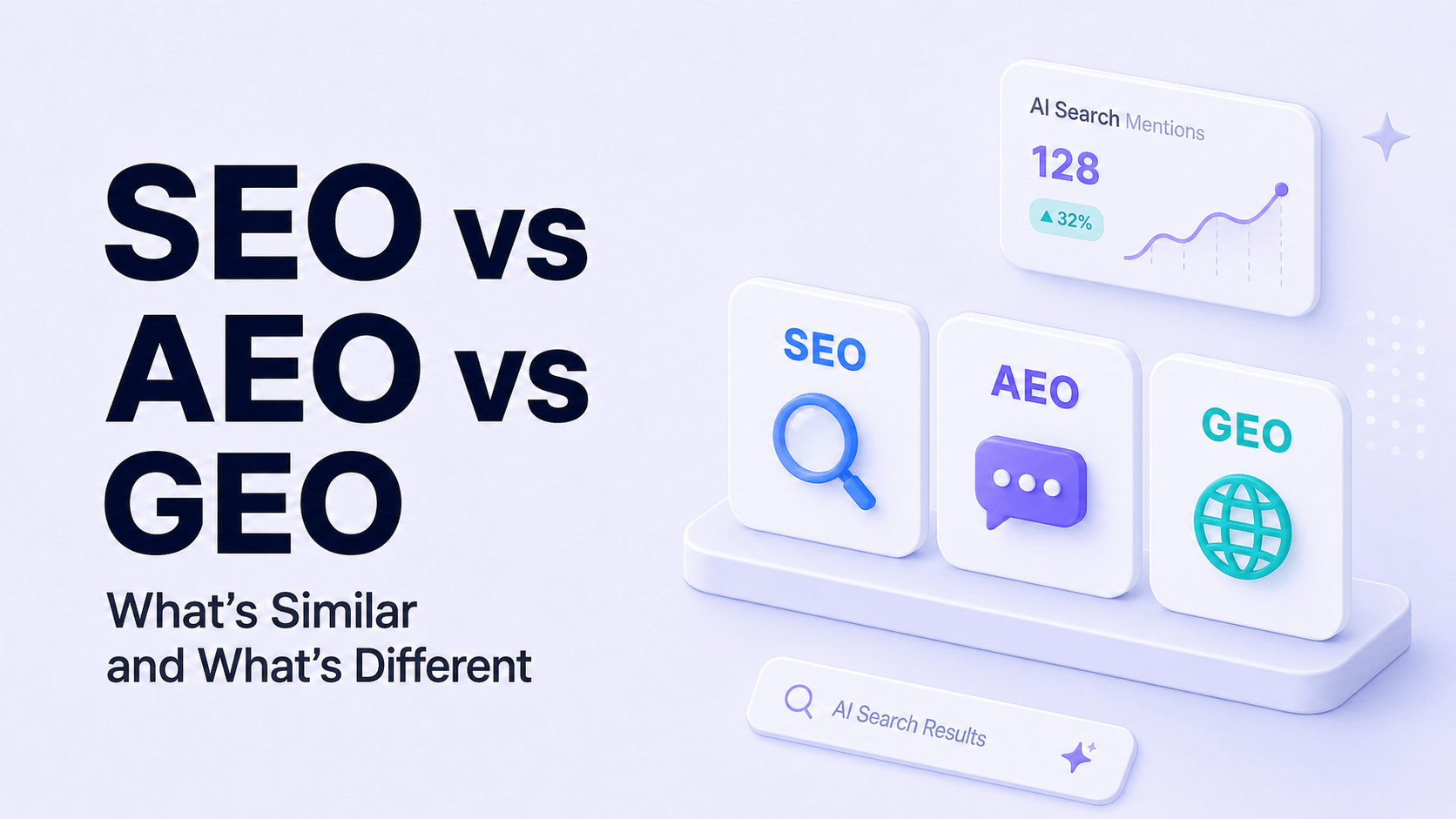
SEO vs AEO vs GEO — comparing the three
| Category | SEO (Search Engine Optimization) | AEO (AI Search Optimization) | GEO (Generative Engine Optimization) |
|---|---|---|---|
| Goal | Rank high in search results | Get your brand cited in AI answers | Have AI reference your content when building answers |
| Target | Google, Naver search engines | AI search (ChatGPT, Perplexity, etc.) | All AI-generated answers |
| Success metric | Page-one search ranking | Cited as "According to [Brand]~" | Your information woven into the answer |
| Scope | Keyword-focused | Citation and recommendation focused | Content becomes AI training and reference material |
A simple analogy: SEO is getting your book on the front shelf of a library. AEO is the librarian recommending your book directly. GEO is the librarian quoting your book when writing an answer. AEO and GEO overlap, but GEO is the broader concept that includes AEO. Read more on SEO, AEO, and GEO differences
What content AI prefers for GEO
When AI generates answers, what content does it pick as raw material? Research points to four core conditions.
Authoritative source citations
Specific numbers and data
Clear structure
Question-and-answer format
Practical GEO steps for small businesses
"So what should my shop actually do?" Here are three realistic steps.
First, create expert content for your industry
Write posts grounded in your experience and expertise — like "Scalp care tips from a hairstylist with 20 years of experience." AI prefers content from real practitioners.
Second, answer questions customers actually ask
Publish clear answers to real questions — "When can I get nails wet after a manicure?" or "How long does an interior quote take?" — on your homepage or blog.
Third, publish specific facts about your business
Hours, price range, service duration, ingredient sourcing — the more concrete facts you publish, the higher the chance AI will reference you.
A strategy that covers both AEO and GEO
Good news: you do not need separate prep for AEO and GEO. Both come down to "creating content AI can trust and use." Read alongside our AEO explainer for a clearer picture.
Practical checklist
- Add an FAQ page to your homepage
- Write industry expertise on your blog in Q&A format
- Cite sources or experience in every post
- Structure titles and subheadings clearly
With Alleo's homepage AI analysis, you can get a free diagnosis of how well your site responds to AI search — including improvement points from a GEO perspective, not just SEO.
"The era when a few blog posts could rank first in search —
today's shift to AI is that same early-entry opportunity."
Business owners who start first become regular ingredients in AI answers. See also our first 3 steps for AI search.
Frequently asked questions
Q1. Is GEO only for large enterprises?
No — small businesses can actually have an advantage. Specific expert content for a local area or niche is often better created by a neighborhood specialist than a large company, and AI prefers information grounded in real experience.
Q2. Can I do GEO without SEO?
SEO and GEO work best together. Content that ranks well in search engines is also easier for AI to discover. That said, GEO emphasizes clear answers and expertise more than simple keyword lists.
Q3. How long until GEO results show up?
It can take weeks to months for AI models to learn from or reference your content. But real-time search-based AI like Perplexity can reflect new content relatively quickly. The key is steadily building high-quality content.