AI search is changing again
When people ask questions in search boxes today, Google often shows an AI summary instead of ten blue links. ChatGPT, Google AI Overviews, and Perplexity are leading examples.
The way these systems build answers is changing once more — because of a technology called GraphRAG.
In simple terms, AI retrieval is evolving from "collect text fragments and patch them together" to "find the right answer on a connected knowledge map."
What is GraphRAG? A plain-language explanation
Traditional AI search (RAG) worked like this:
- 1A question comes in
- 2Find related text chunks
- 3Stitch them together into an answer
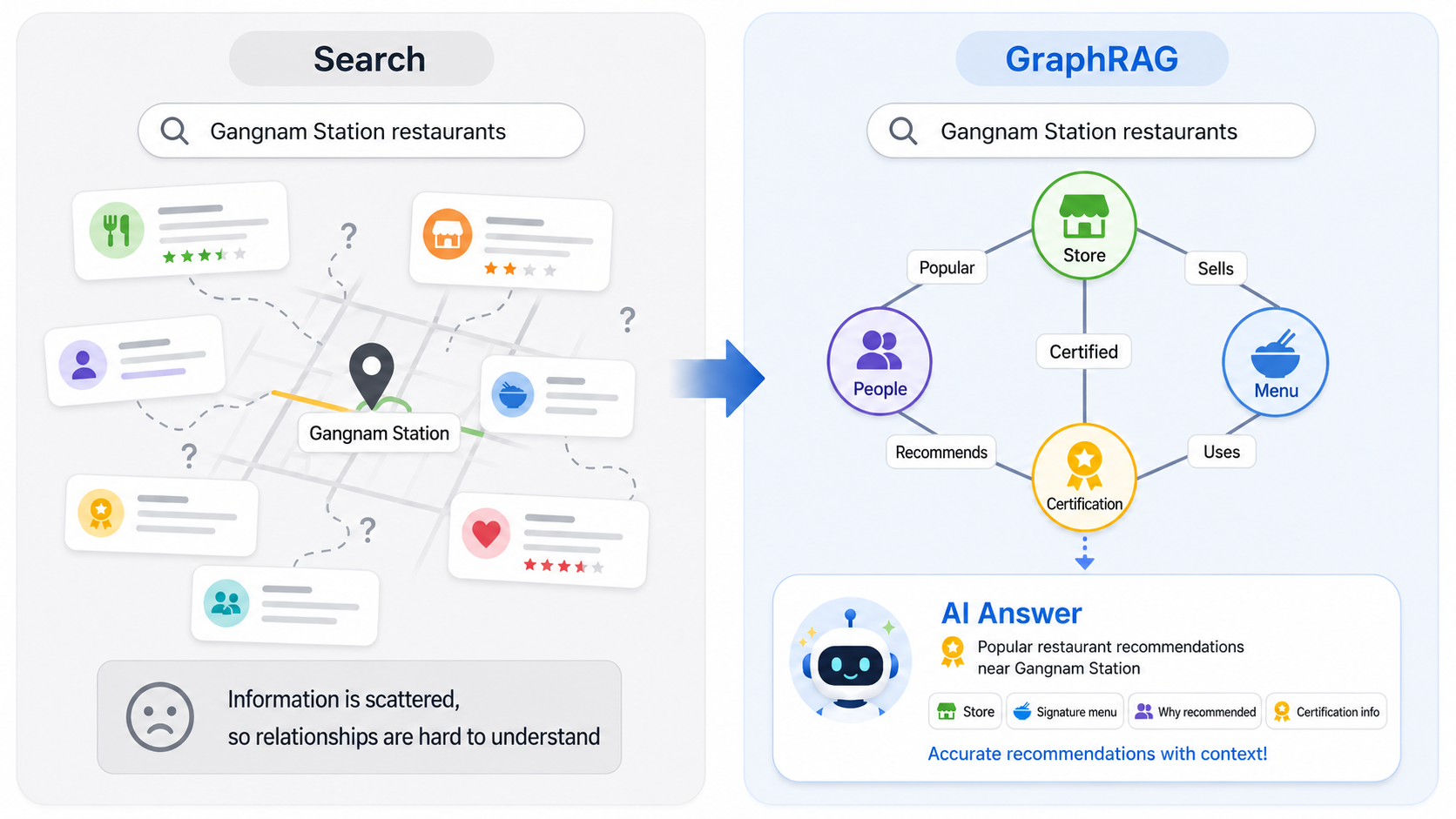
The problem is that AI often misses context and relationships. Search for "restaurants near Gangnam Station" and it may gather nearby text without understanding which store is known for which menu or certification.
GraphRAG is different. Developed by Microsoft Research, it organizes information as a knowledge graph.
Nodes
Entities such as stores, products, people, and certifications
Edges
Relationships such as "this store holds this certification" or "this store sells this product"
Instead of searching a pile of text, AI follows a connected map — and can produce answers that are more accurate and context-aware.
Why does this matter for small businesses?
AI must recognize your store as an entity before it can recommend you in AI search results.
Imagine someone asks AI: "Recommend an organic bakery near Gangnam Station." A GraphRAG-style system might search like this:
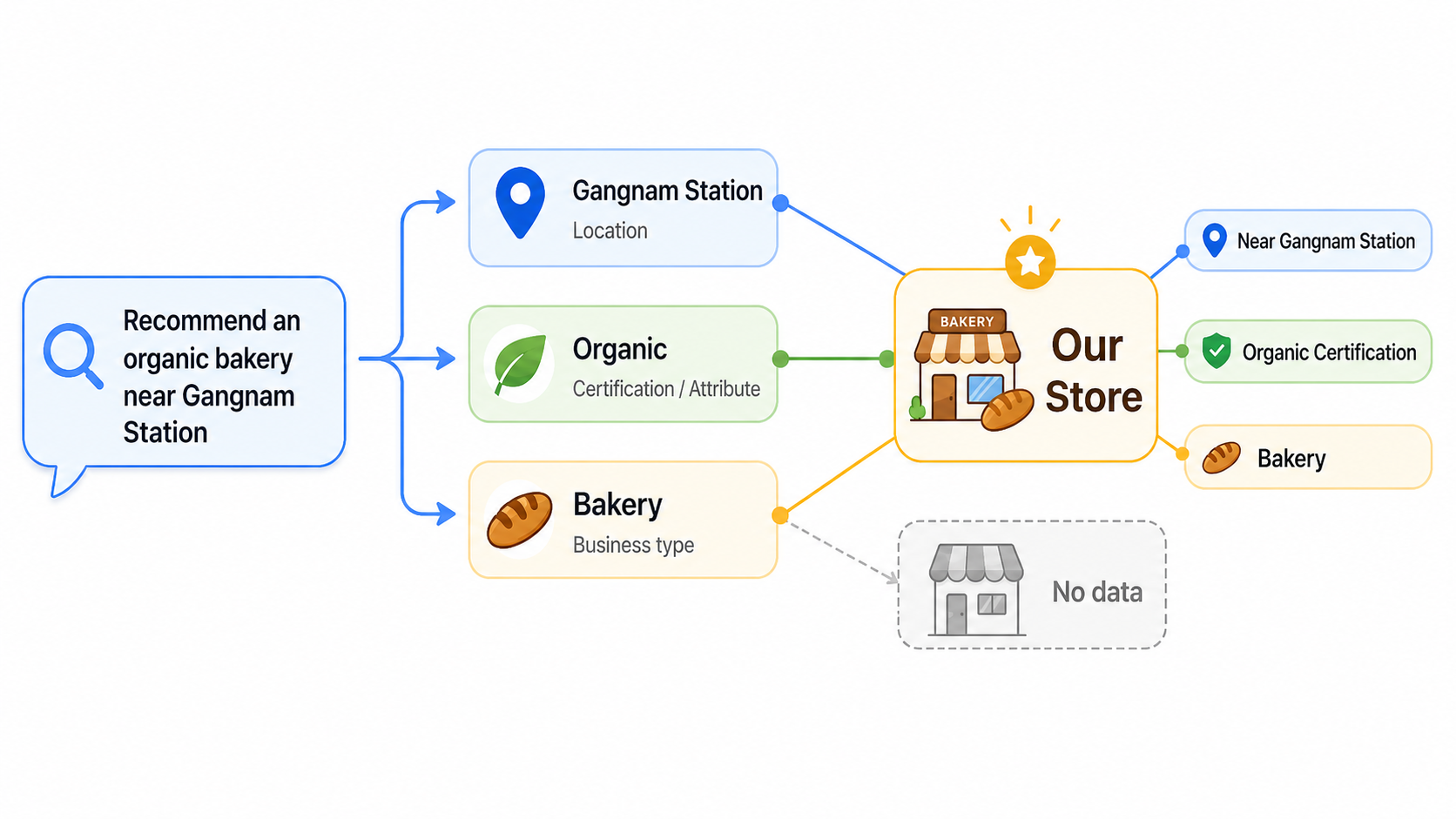
"Gangnam Station"
→ Location entity
"Organic"
→ Certification or attribute entity
"Bakery"
→ Business category entity
It then finds stores where those three entities connect. If your homepage does not present that information in a structured way, AI may never find you — no matter how good your bread is.
What should you do? Three practical steps
Organize your business information so machines can read it
A homepage that looks good to humans is not enough. You need structured data (Schema.org markup) that AI can parse: industry, location, hours, menu, and reviews in a standard format.
Keep your brand identity consistent everywhere
If your store name, address, and phone number differ across your website, Naver, Instagram, and blog, AI may not know they refer to the same business. Consistency across channels is the core of entity integrity.
Write content that shows relationships, not keyword lists
Instead of repeating "Gangnam bakery," write sentences like "Five minutes from Gangnam Station, we have baked with organic flour for 10 years in an HACCP-certified kitchen." Relationships between entities matter more than keyword density.
How Alleo helps you respond to this shift
This shift can feel overwhelming. Structured data, entity consistency, AEO (AI Engine Optimization)... the vocabulary alone is unfamiliar. Kroffle built Alleo to solve exactly this problem for small businesses.
AI homepage health check
Diagnose SEO, GEO, and AEO in one place. See right away how visible your homepage is in AI search and where you stand versus competitors.
Affordable small-business homepage builds
We build from the start with a structure AI can read. You can get started without heavy upfront cost.
Interview-based content generation
We turn a short interview with you into industry-specific content where entity relationships appear naturally.
SEO/GEO/AEO-ready blog
A blog designed to perform well for both search engines and AI answer engines.
Alleo handles the optimization so small businesses do not have to chase every technical shift like GraphRAG on their own.
In summary
| Traditional SEO | AI-era SEO (AEO/GEO) |
|---|---|
| Stuff in as many keywords as possible | Make entities and relationships explicit |
| Win with volume of text | Use structured data AI can read easily |
| Compete for search rankings | Goal: be included in AI recommendations |
| Optimize for humans only | Optimize for humans and AI together |
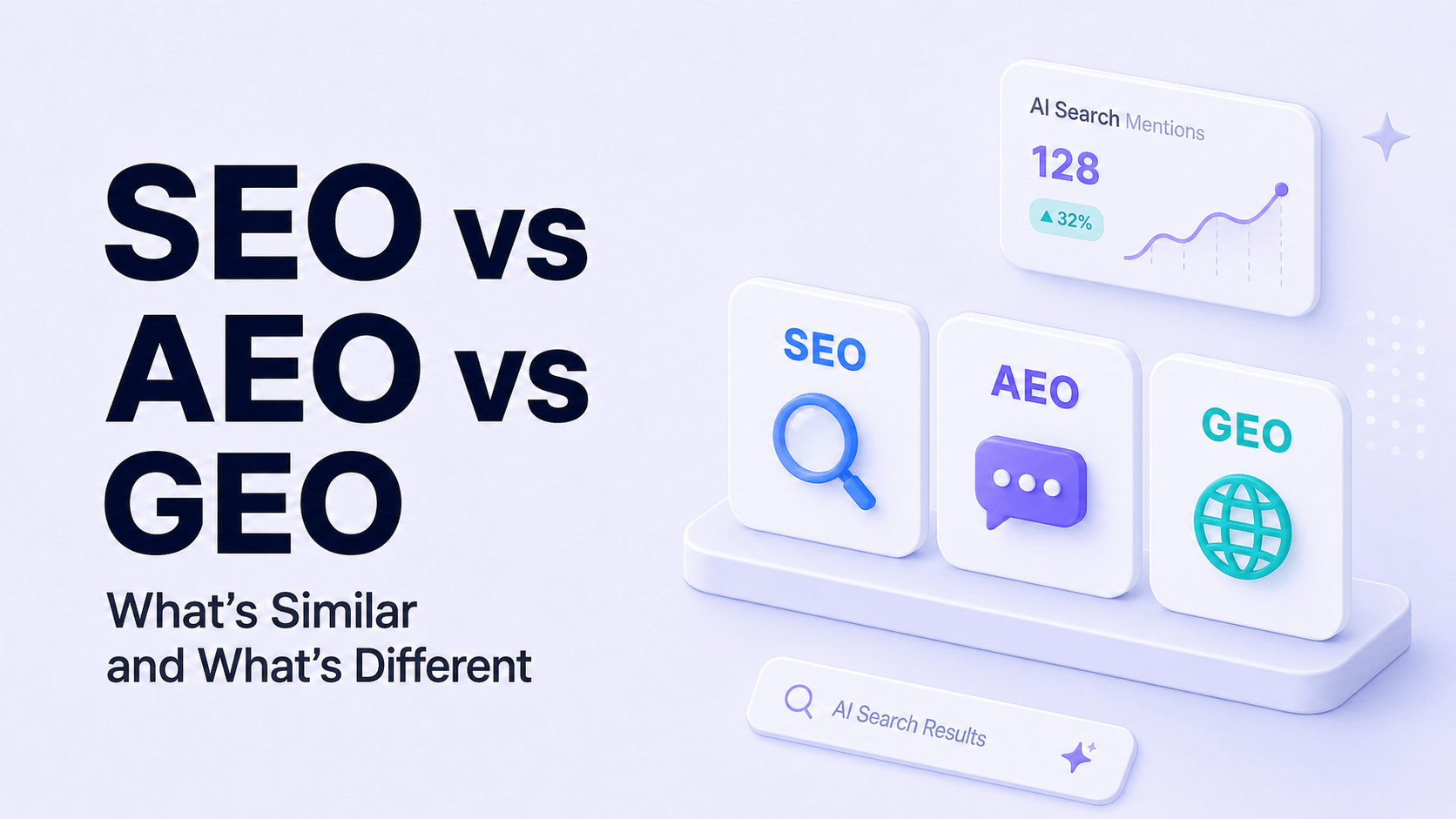
You cannot reverse the direction of AI search. What matters is preparing now. Read our SEO vs AEO vs GEO guide for more context.
Run Alleo's free homepage diagnosis to see how ready your business is for AI search. Sign up now to use every feature for free.
Frequently asked questions
Q1. How is GraphRAG different from traditional AI search (RAG)?
Traditional RAG finds text chunks similar to a question and stitches them together. GraphRAG builds a knowledge graph where stores, products, and certifications are nodes and their relationships are edges. That makes complex, multi-condition questions easier to answer accurately.
Q2. Do small businesses need to prepare for the GraphRAG era?
Yes. AI search is shifting from text matching to relationship understanding. If your homepage and blog do not present your store, certifications, location, and menu as structured entities, your business may never appear on AI's knowledge map.
Q3. What is entity consistency?
It means your store name, address, and phone number stay identical across your website, Naver, Instagram, blog, and other channels. If information is fragmented, AI may not confidently treat those mentions as the same business.
Q4. Is keyword SEO alone no longer enough?
In the GraphRAG era, it is not enough on its own. Content that shows how location, certification, category, and experience connect — plus structured data such as Schema.org — matters more than repeating target keywords.